Santa Croce Florence: Tombs, Frescoes and Pazzi Chapel
Updated: 15 hours ago
Updated October 2026

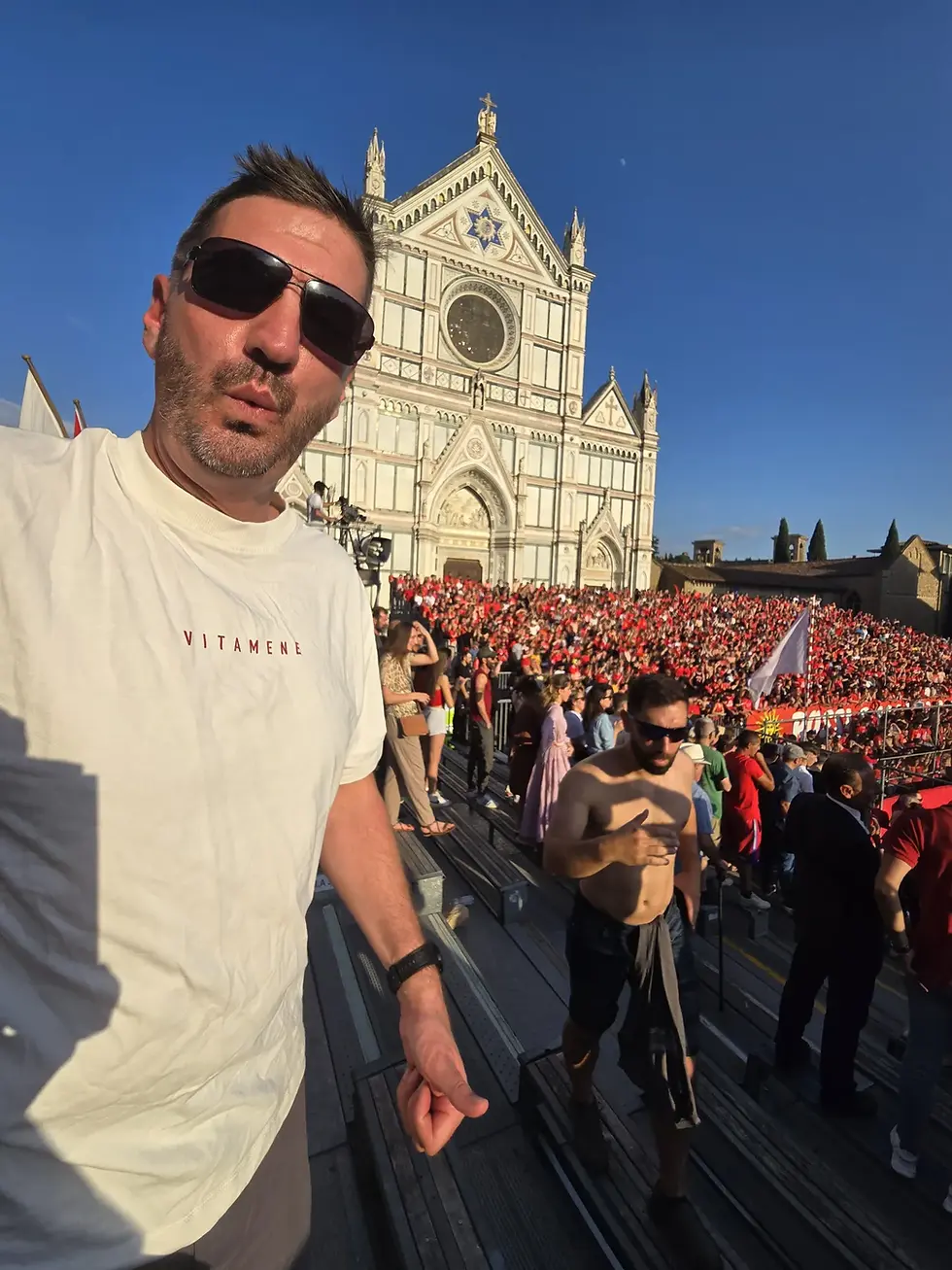
I have been to Piazza Santa Croce at midnight in August and in June with the Calcio Storico stands full. Inside the basilica it is always quiet, and standing by Michelangelo's tomb never gets old.

Santa Croce is the great Franciscan basilica of Florence and the resting place of many of the names behind the Florence Renaissance.

The tombs of the greats
Santa Croce is often called the Temple of the Italian Glories. Walk the aisles and you will find:

Michelangelo, with a tomb designed by Vasari.
Galileo Galilei, opposite him across the nave.
Niccolo Machiavelli, author of The Prince.
Gioachino Rossini, the composer.
A memorial to Dante, who is actually buried in Ravenna. My Dante's Florence guide tells the story of why.

Giotto's frescoes
To the right of the main altar, the Bardi and Peruzzi chapels hold frescoes by Giotto, including scenes from the life of Saint Francis. They are the roots of Renaissance painting, a century before Brunelleschi's dome. See my Florence Duomo guide to compare the two.

The Pazzi Chapel
Off the first cloister is Brunelleschi's Pazzi Chapel, a small, perfect space in grey stone and white plaster. It is included in your ticket, and it is the room I tell everyone not to skip.

The leather school
Behind the basilica, the Scuola del Cuoio teaches leatherwork in the old convent buildings. You can watch artisans at work and shop. For more workshops, read my Florence leather guide.
Visiting tips (2026)
Monday to Saturday 9:30 to 17:30. Sunday and religious holidays 14:00 to 17:30.
Last admission at 17:00. Closed 25 December.
Shoulders and legs must be covered. Free disposable covers are offered at the entrance.
Allow about 50 minutes. Booking online is recommended.

The piazza through the year
Piazza Santa Croce hosts the Calcio Storico in June and a Christmas market from 14 November to 20 December 2026. Outside those weeks, it is one of my favorite squares to sit with a coffee and watch the city go by.
How it compares
For the Medici church and Michelangelo's sculptures, see my San Lorenzo Florence guide.

Where to stay nearby
Santa Croce is lively, full of restaurants and close to everything. See where to stay near Santa Croce.
How I walk the basilica
I go in a fixed order so I do not miss anything. Down the right aisle first: Michelangelo, the Dante memorial, Alfieri, Machiavelli and Rossini. Then the transept and the Giotto chapels, with the Bardi Chapel's Saint Francis scenes and the Peruzzi Chapel's two Johns.
Across to the left aisle for Galileo and Ghiberti, then out to the first cloister for the Pazzi Chapel. Last stop is the museum in the old refectory, where Cimabue's Crucifix hangs.

Cimabue's Crucifix and the 1966 flood
On 4 November 1966 the Arno burst its banks and Santa Croce, in the lowest part of the city, was under several meters of water and mud. Cimabue's great painted Crucifix was among the worst damaged works in Florence, and its restoration became a symbol of the city's recovery.
Today it hangs raised high above the floor, so a future flood cannot reach it. Look for the plaques around the neighborhood marking how high the water rose. It is a sobering sight.

Monuments outside
On the steps, the large statue of Dante watches over the piazza. It was unveiled in 1865 for the sixth centenary of his birth. The facade itself is a 19th century neo-Gothic addition. The Star of David high above the door is a nod to its architect, Niccolò Matas, who was Jewish.

Art beyond the tombs
Do not rush past the walls between the monuments. Donatello's Annunciation, carved in gilded pietra serena, stands on the right aisle and is one of the most tender sculptures in the city. His wooden Crucifix is in the Bardi di Vernio chapel in the left transept, the one Brunelleschi famously teased him about.
In the sacristy, look for the relic display of Saint Francis's robe. And in the Baroncelli Chapel, Taddeo Gaddi's frescoes include one of the first night scenes in Western painting, the annunciation to the shepherds lit by an angel.

Best time to visit
I go at opening on a weekday or late in the afternoon. Cruise groups and school tours peak between ten and one. In summer, the cool stone interior is a relief after the hot piazza, and in winter the late afternoon light through the stained glass in the apse is beautiful.

Tickets and entrance
The visitor entrance is on the left side of the basilica, on Largo Piero Bargellini, not through the main doors. Arrive dressed for a church, with shoulders and knees covered, and keep your voice low inside. One ticket covers the basilica, the Pazzi Chapel, the cloisters and the museum.

Around Santa Croce
The neighborhood is full of trattorias, leather workshops and gelato. Vivoli, one of the oldest gelato shops in Florence, is a few streets away. For dinner, see my best pasta in Florence, and for June's ancient football match read my Calcio Storico guide.
The Franciscan story behind the basilica
Santa Croce was built for the Franciscans, the order founded by Saint Francis of Assisi, who preached poverty and worked among the poor. The friars arrived in Florence in the early 1200s and settled in what was then a marshy area outside the walls, home to wool workers and dyers.
The present basilica was begun in 1294, probably to a design by Arnolfo di Cambio, the same architect who started the Duomo and Palazzo Vecchio.
That is why the interior feels so open: a wide nave built for preaching to large crowds, with a simple timber roof rather than stone vaults.
Wealthy banking families, including the Bardi, the Peruzzi and the Baroncelli, paid for the chapels around the altar, which is how Giotto and his followers came to paint them. Walking the nave, I like to remember that this grand church began as a place for sermons to ordinary Florentines.

The facade and the bell tower
The marble facade looks medieval but dates from the 1850s and 1860s, designed by Niccolò Matas and paid for in part by an English benefactor, Sir Francis Sloane. The Star of David at the top is a sign of the architect's heritage.
The bell tower is also 19th century. Many visitors are surprised that Florence's great churches waited centuries for their fronts; the Duomo and San Lorenzo tell the same story.

The cloisters and the museum
After the church, I always walk through the two cloisters. The first leads to the Pazzi Chapel; the second, designed in the Renaissance style, is one of the quietest spaces in the city.
The Opera di Santa Croce museum, in the old refectory, holds Cimabue's restored Crucifix, Taddeo Gaddi's Last Supper and Tree of Life, and Donatello's gilded Saint Louis of Toulouse. Most people rush past it. Give it twenty minutes.

Reading the floor
Look down as you walk. The floor of the nave is covered with worn tomb slabs, many with carved figures, coats of arms and Latin inscriptions.
Some have been smoothed almost flat by seven centuries of feet. I find them as moving as the grand monuments along the walls: these are the ordinary Florentines who wanted to rest near the friars.

Photography and etiquette
Photos without flash are generally allowed in the basilica. Services are still held here, so stay quiet near the chapels in use and do not enter roped areas.

FAQ
Who is buried in Santa Croce?
Michelangelo, Galileo, Machiavelli and Rossini, among many others.
Is the Pazzi Chapel included?
Yes, it is part of the basilica ticket.
Is there a dress code?
Yes. Cover shoulders and legs.
How long do I need at Santa Croce?
About 50 minutes for the basilica, an hour and a half if you add the museum and cloisters.
When is Santa Croce open on Sundays?
On Sundays and religious holidays it opens from 14:00 to 17:30.
About the author
I'm Jason GaNung, and I write every guide on Florence Life. I have spent extensive time in Florence over many trips, and I have stayed in many of the hotels and villas I cover, so my picks come from my own stays, not press releases. More about me.
Read next
More photos from Santa Croce
Plan my stay
Want to stay in one of the liveliest neighborhoods in the center? Plan my Florence stay


Comments